
What happens after glass breaks: the first question to ask about safety film
Picture a customer walking into a shopfront door, or loose debris striking a window during a squall. The first concern is where the fragments go and whether the opening stays closed. Safety film can help manage those outcomes under tested conditions. It cannot promise that the glass will never break.
This English adaptation follows our Thai guide through the International Window Film Association’s Safety & Security Education Guide (2023). We start with the glass and the film, then move through storms, earthquakes, blasts, intrusion and the test reports behind each claim. Along the way, we ask what those examples mean for buildings in Thailand. The IWFA manual does not certify a MAXXMA product. A qualified professional must still assess the actual glazing and local requirements.
Safety & Security Education Guide
Published by International Window Film Association (IWFA) · 2023 edition
This 37-page manual explains glass types, safety-film construction and edge retention, then examines tests for human impact, storms, seismic movement, blasts and intrusion.
Start with the hazard, not the film thickness
The guide traces safety-film development to efforts in the United Kingdom in the early 1970s to reduce injuries from flying glass after explosions. Later storms, earthquakes and attacks broadened interest. These events differ: a glazing system that limits injury from a person walking into a pane has not thereby proved it can resist storm debris or forced entry (IWFA PDF p. 3).
The terms glass-fragment retention film and anti-shatter film describe the central task more precisely: retain broken glass. Film is generally applied to the interior face of existing glazing with pressure-sensitive adhesive. Its polyester can stretch and absorb some energy, yet the film, adhesive, edge or frame may fail beyond the tested conditions (IWFA PDF pp. 2, 6-7). Identify the actual pane and frame, choose the hazard, and then read the corresponding system test and achieved rating.
02 · KNOW THE GLASSFour glass types, laminated glazing and the role of the frame
Before asking what a film can do, look at how the pane breaks. Sharp shards, small tempered pieces and glass held by an interlayer leave very different problems to solve.
Most flat glass begins with the float process. Annealed glass can be cut and is common in buildings, but it typically breaks into sharp pieces. Heat-strengthened glass resists more stress than annealed glass yet has a similar break pattern. Tempered glass is stronger and breaks into small pieces. Chemically strengthened glass is used mainly where thin, strong glass is needed; strength alone does not make every product suitable for safety glazing (IWFA pp. 2-4).
Laminated glass bonds two or more plies through an interlayer such as PVB. That layer can hold broken glass together. It differs from tempered glass, which breaks into small pieces but needs the opening to retain them. Purpose-built ballistic or blast-resistant glazing can combine multiple glass and plastic layers with a specially designed frame. It cannot be equated to a film fitted to an existing pane (IWFA pp. 4-5).
A window may use a single pane, an insulated glazing unit, a laminate or a specialist protective assembly. Its performance depends on the glass, film, adhesive, seal, frame and frame-to-building connections. A film-only data sheet does not establish what the whole opening will do after impact.
From float glass to four different break patterns
Float glass flows across molten tin, is annealed, and is cut. Further processing changes its strength and fracture behaviour (IWFA PDF pp. 3-5):
- Annealed: widely used and cuttable, but it breaks into potentially sharp large and small pieces.
- Heat-strengthened: described in the guide as roughly twice as strong as annealed glass, yet with a similar sharp fracture pattern. It is not automatically human-impact safety glazing or fire-rated glass.
- Tempered: described as roughly four times as strong. It breaks into small granules and cannot be cut after tempering; the entire broken pane can still leave a weak frame.
- Chemically strengthened: ion exchange strengthens the surface of thin specialty glass. It may still fracture like annealed glass, so its name does not prove a safety result.
A glazing unit is more than its visible pane
The guide uses US-market examples of about 3 mm monolithic residential and 6 mm commercial glass. These are examples, not Thai code requirements. An insulated glazing unit (IGU) seals two or three panes around a spacer. The face receiving film matters for heat and stress. Laminated glass bonds panes through an interlayer such as PVB; ballistic and blast-resistant assemblies may add polycarbonate and require purpose-built frames (IWFA PDF pp. 5-6).
Causes of breakage include human impact, forced entry, debris and pressure, seismic drift, blast, nickel-sulfide inclusions in tempered glass, thermal stress and unsuitable structural design. Diagnose the cause and inspect the frame before treating film as the answer (IWFA PDF p. 5).
03 · FILM CONSTRUCTIONHow film can hold fragments together, and where it can fail
Clear safety film may use one or several laminated polyester plies. A pressure-sensitive adhesive bonds it to the room-side glass; a scratch-resistant coating often protects the exposed face. When the glass fractures, the film can stretch and absorb energy while holding fragments together. Sufficient force can still tear the film or pull the filmed pane out of the frame (IWFA pp. 6-9).
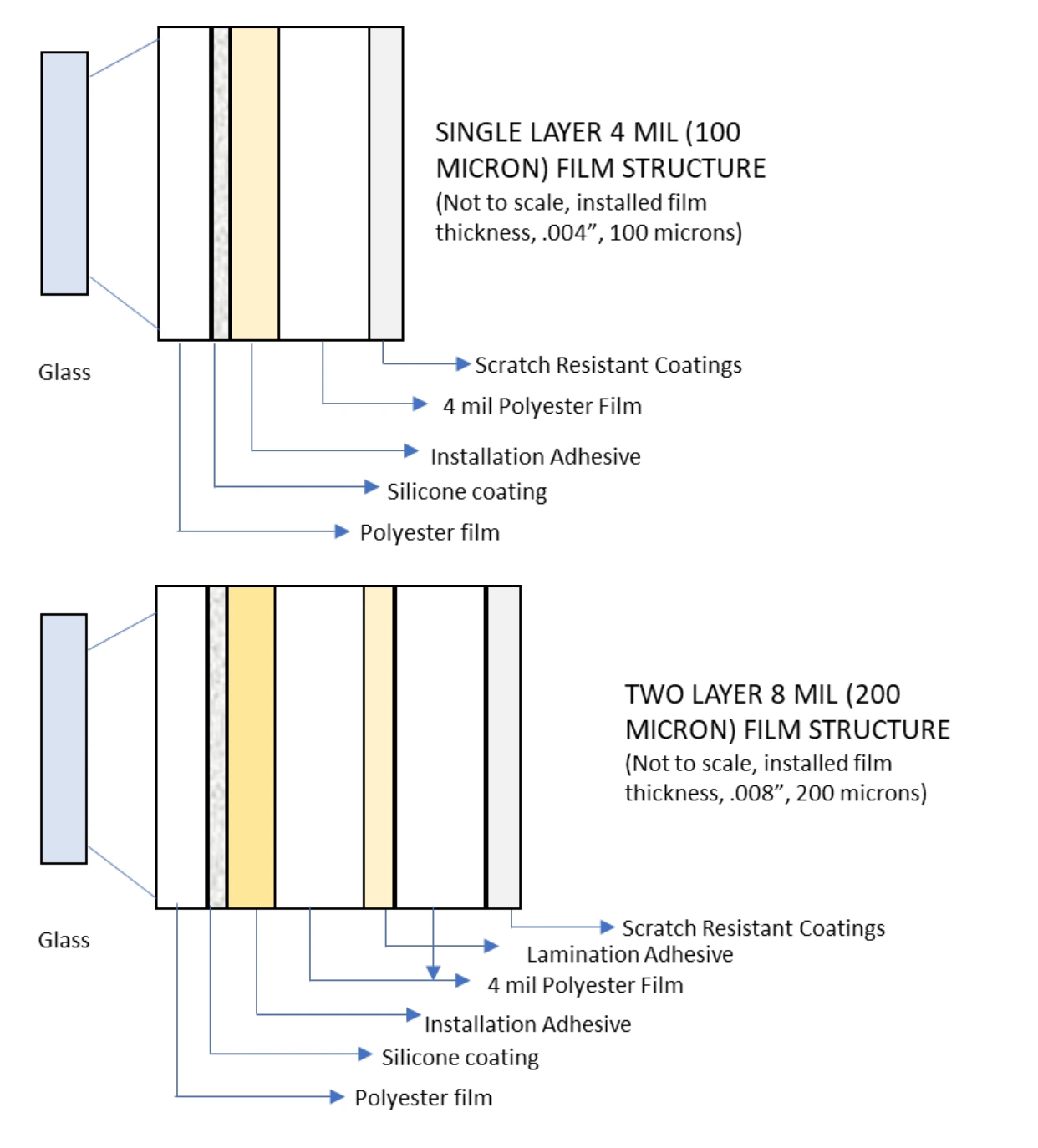
Cropped from the IWFA PDF, page 8. These are example constructions, not MAXXMA product specifications.
Thickness, ply count, tensile strength and tear strength describe the material, but none alone predicts an actual event. The adhesive that laminates plies may differ from the adhesive that fixes film to glass. Peel data depends on cure time, temperature and test angle. A weight hung from a strip on an installed window is not a controlled substitute for a standard laboratory test (IWFA pp. 8-9).
UV absorbers protect film materials and can address one contributor to interior fading. They cannot stop all fading. Solar safety film adds solar-control layers, which means the glass and film combination also needs a thermal-compatibility review.
What four, eight or twelve mil really means
One mil is 0.001 inch, or 25.4 micrometres. The guide discusses films around 4-15 mil and thicker. Its eight-mil example combines two four-mil PET plies; a twelve-mil construction may use three. Ask whether thickness means the full product excluding its release liner, or only the load-bearing PET. Adhesive, hard coat and solar layers add to the total (IWFA PDF pp. 6-8, 34).
Greater thickness can help in some tests but does not convert linearly to a storm, blast or intrusion rating. Broken glass may cut PET, film can tear, or the entire sheet can leave an inadequate frame. A matching assembly test matters more than the mil figure alone.
Two adhesive roles and cure time
Adhesive joining PET plies can differ from the pressure-sensitive acrylic adhesive fixing film to glass. The latter must retain fragments after impact. A release liner protects it before installation, and a hard coat commonly faces the room (IWFA PDF pp. 8-9). Adhesion reports need cure time and conditioning; a newly installed pane need not behave like a fully cured laboratory specimen.
04 · MATERIAL DATAWhat thickness, tensile, abrasion and peel tests can tell you
The figures on a data sheet may sit side by side, but they answer different questions. Some describe the film, some the adhesive, and only an assembly test can show how the complete opening performed.
IWFA’s appendix identifies material tests such as ASTM D882 for tensile properties, ASTM D1044 for abrasion-related haze change, ASTM E84 for flame spread and smoke, and ASTM D3330 for adhesive peel. Reports should state the units, film direction where relevant, specimen construction and adhesive cure conditions (IWFA pp. 33-34).
These are useful material measures. They do not demonstrate blast, storm or forced-entry performance. For a safety objective, ask for a test that simulates that event on the glazing assembly being proposed.
Peel is not shear
In a peel test, film is lifted away from glass at a stated angle, often 90 or 180 degrees. In shear, the force runs parallel to the pane. The manual shows that thin and thick films bend differently, changing effective peel geometry. Compare adhesion values only after checking angle, strip size, cure, rate and temperature (IWFA PDF pp. 9-10).
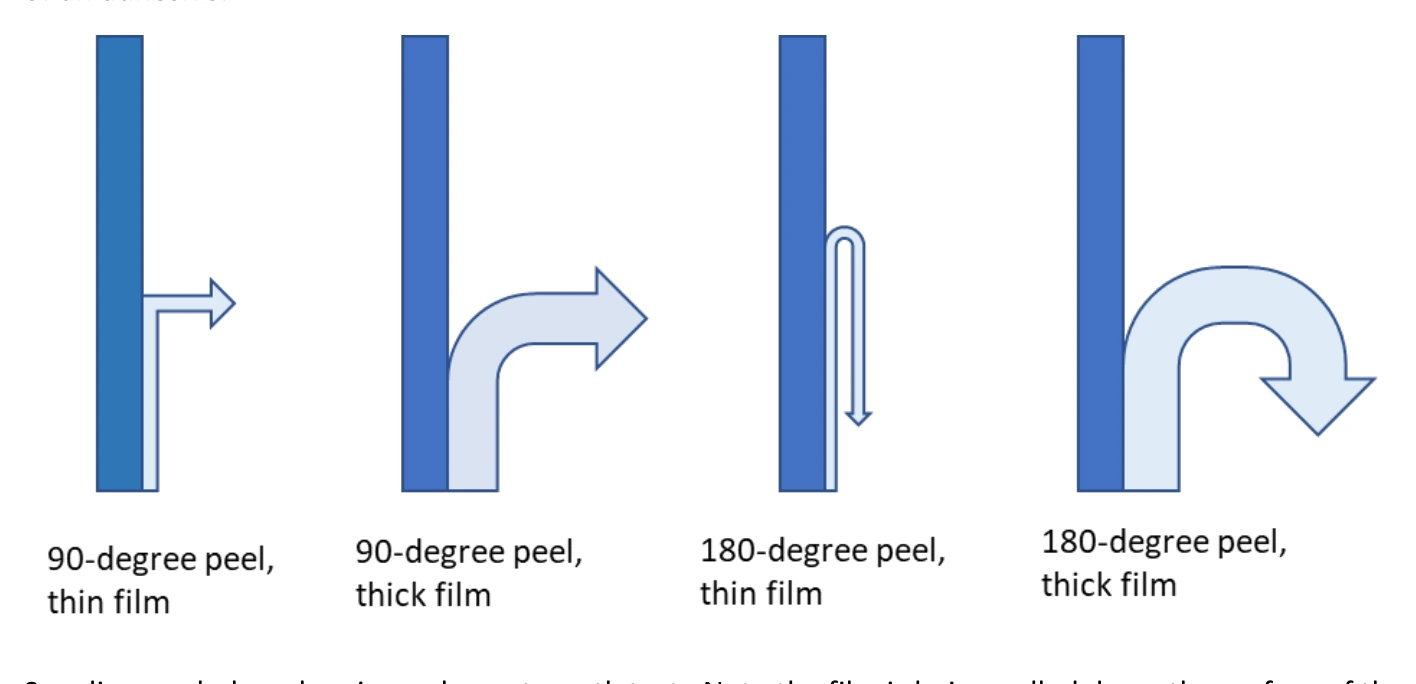
IWFA PDF page 9: film thickness and pull angle change the peel geometry.
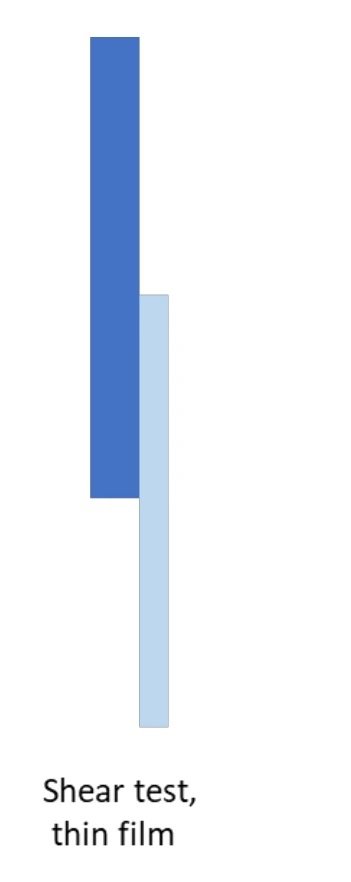
IWFA PDF page 10: shear loads the adhesive along the glass face.
Appendix A is a material-data checklist
- EN 15752 section 6: distinguish full product thickness excluding release liner from PET-only thickness.
- ASTM D882: report tensile and break strength and elongation in machine and transverse directions.
- Tear resistance: the manual prints “ASTM D1001” beside tear strength, while ASTM identifies D1004 as the Graves tear method for plastic film. Confirm the method and edition with the laboratory before specifying it.
- ASTM D1044: the manual describes a CS10F wheel, 500 g load, 100 revolutions and change in haze.
- ASTM E84 and D1929: concern flame spread/smoke and ignition characteristics, not an entire fire-resistant window rating.
- ASTM D3330: the guide discusses a one-inch strip, a 180-degree peel and pounds per inch, with cure and wet or dry application recorded (IWFA PDF pp. 34-35).
These properties support quality comparison. Occupant or building safety claims require separate impact, pressure, racking or blast tests.
05 · HEAT AND DURABILITYClear film, solar safety film and thermal-stress breakage
If you want fragment retention and solar control together, the film name is only a starting point. Sunlit glass can have a temperature difference between its centre and shaded edges, so compatibility needs its own check.
Thermal stress develops when one area of a pane heats faster than a shaded edge under the frame. A fracture can start at the edge and progress into the pane. The IWFA manual describes clear safety film as having little effect on this risk in typical circumstances. A solar-control safety film may change absorption, so its manufacturer’s film-to-glass guidance and the actual glazing, shading and insulated units need review (IWFA pp. 10-11).
Exterior safety film faces a different exposure. The IWFA guide does not evaluate its exterior performance in detail. Ask its manufacturer for product-specific service-life and system-test evidence rather than applying an interior-film result to an exterior installation.
Clear safety and solar safety film are different constructions
Clear film focuses on fragment retention and may absorb UV. Solar safety film adds light and heat-control layers. The manual illustrates a vacuum-coated aluminium example; its glare, privacy and heat behaviour cannot be assumed for every product (IWFA PDF pp. 10-11).
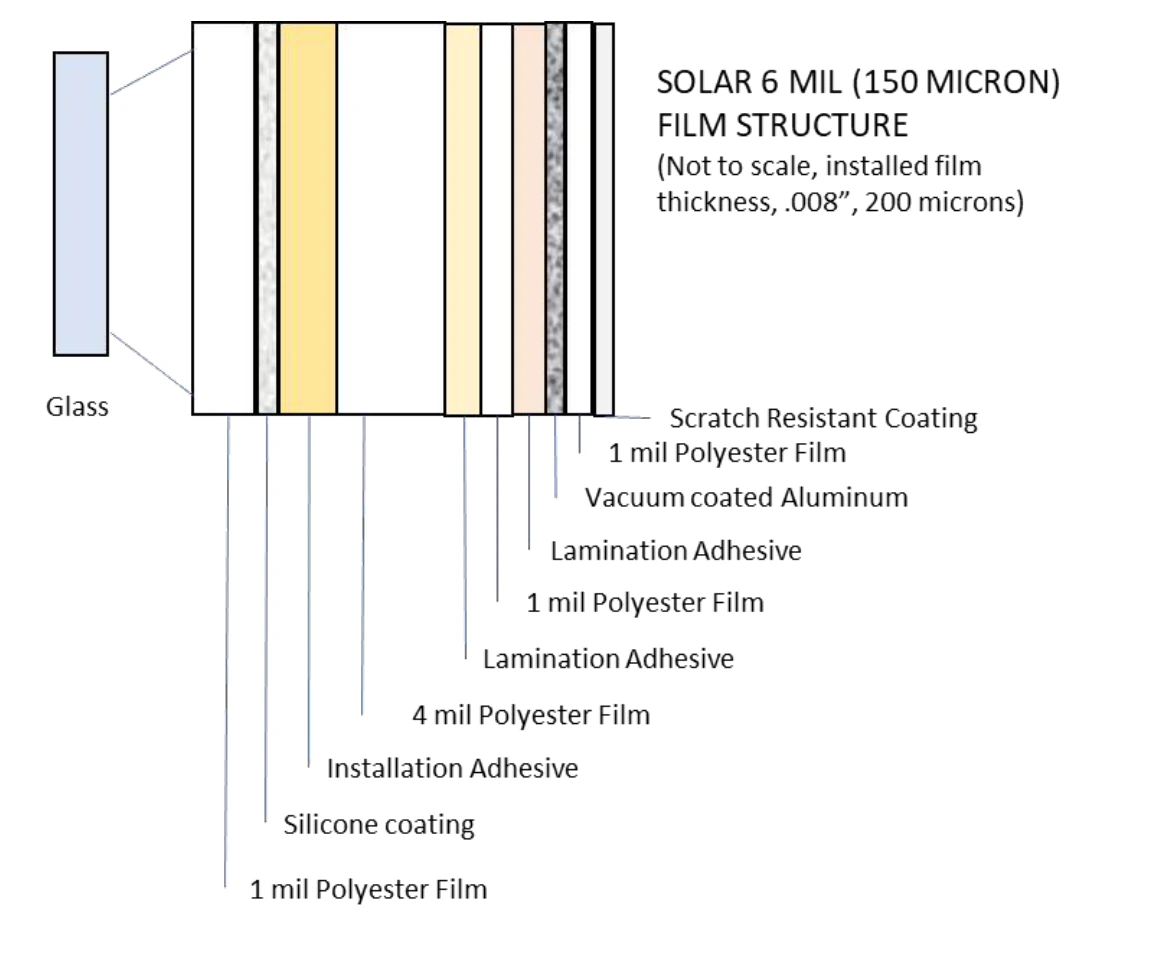
IWFA PDF page 11: one example construction, not a universal formulation.
A thermal crack may begin perpendicular to a cooler framed or shaded edge and then turn toward the warmer centre. Clear safety film generally adds little thermal risk according to the guide. More solar absorption calls for the manufacturer’s film-to-glass application guidance and assessment of glass type, thickness, size, IGU configuration and shade (IWFA PDF pp. 11-12). UV filtering reduces one cause of fading; visible light, heat and material chemistry also contribute.
06 · HUMAN IMPACTReading ANSI Z97.1 and CPSC 16 CFR 1201 impact results
Start with a familiar scene: someone collides with an entrance door. These methods ask whether a dangerous opening remains after impact, rather than treating a material-strength figure as the answer.
These tests address people walking or falling into hazardous glass locations such as doors and low partitions. ANSI Z97.1 swings a weighted bag into a framed specimen. If glass breaks, the test limits the size of the resulting opening. The pass criterion does not require the glass to stay unbroken (IWFA pp. 12-13).
- Class C: 12-inch drop, approximately 100 ft-lb
- Class B: 18-inch drop, approximately 150 ft-lb
- Class A: 48-inch drop, approximately 400 ft-lb
Within the test framework described in the manual, CPSC 16 CFR 1201 Category I corresponds to Class B and Category II to Class A. A credible claim names the class achieved, glass type and thickness, and the installation tested. A human-impact result does not establish storm or blast performance.
What a human-impact pass actually involves
The guide describes a framed specimen about 34 × 76 inches, close to sliding-door dimensions. A 100-pound leather bag filled with lead shot swings into its centre at the drop height for the class. If glass breaks, the opening must not let a three-inch-diameter steel ball pass. Four specimens must pass at that level before a higher level can be claimed (IWFA PDF p. 14). These are the 2023 guide’s details; check the edition cited by a current report.
Doors, sidelights, low partitions, shower glazing and sliding openings are examples of locations where people may strike glass. The method assesses the consequence of impact, not time to defeat an intruder. The manual discusses CPSC Category I/II alongside ANSI classes after a 2015 CPSC method change, but classifications should still be stated as they appear in the report.
07 · WINDSTORMSWhy debris impact and repeated wind pressure must be tested together
A storm pushes and pulls on glazing in repeated cycles. Flying debris can break an opening; a breached building envelope can then alter internal pressure and load other parts of the structure. That is why storm testing considers the complete window and its connection to the building, not a filmed pane alone (IWFA pp. 14-17).
For a Thai building: Thailand’s Meteorological Department reported summer thunderstorms, gusts and hail in some areas in 2026. For a home or shop, ask which panes face exposed winds, what could become flying debris nearby, and whether the frame and fixings are sound. That is our practical interpretation of the hazard, not a claim that Florida wind loads predict conditions at a Thai address.
ASTM E1886 sets out the impact and cyclic-pressure test method, while ASTM E1996 addresses windborne-debris performance and missile categories. The manual discusses small projectiles and larger pieces of lumber in different risk conditions. Historic Miami-Dade examples combine impact with thousands of pressure cycles. Wind maps, code editions and regional requirements change, so a Florida provision is an example of a test context, not a Thai building rule (IWFA pp. 15-21).
At the time of writing, IWFA knew of no retrofit safety film on previously noncompliant existing glass and frames that had passed the specified nine-pound large-missile impact followed by cyclic loading. Passing a small-missile test on one assembly is not approval of a full hurricane protection system. Ask for the applicable authority’s written approval of the specific assembly rather than relying on a general “storm proof” phrase (IWFA pp. 16-21).
Why a broken opening can change roof loading
The guide uses Hurricane Andrew in 1992 to explain how a breached window or door can let wind and rain inside, increase internal pressure and load a roof or wall. Building shape, roof fixing and the surrounding envelope matter. Its hip-roof and gable-roof drawing explains this interaction; it does not certify a roof form (IWFA PDF pp. 15-16).
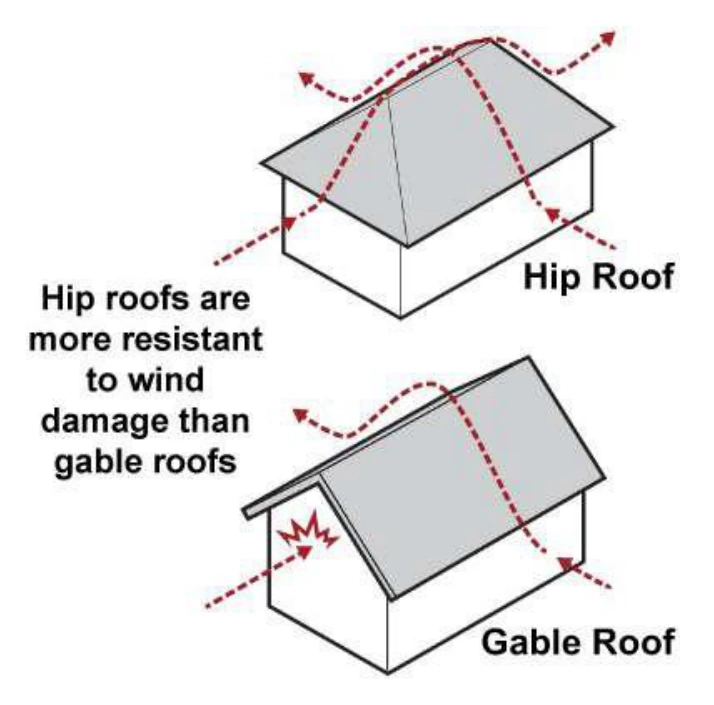
IWFA PDF page 15: storm risk concerns the building and the whole opening.
Miami-Dade’s example: missile first, pressure cycles afterward
For lower openings, the manual describes a large missile: roughly 2 × 4-inch lumber weighing nine pounds, striking at about 34 mph. Three window specimens each receive two impacts, around the centre and near a corner, without penetration. The guide associates this example with openings up to 30 feet above ground (IWFA PDF pp. 16-17).
For higher openings, its small missile example uses approximately two-gram steel balls at about 130 feet per second, in groups of ten aimed at centre, edge and corner, thirty hits per specimen. After impact, the assembly faces alternating positive and negative pressure; the cited Dade example uses 9,000 cycles and also addresses damage and weathering. These figures describe the manual’s protocol, not a current universal building rule (IWFA PDF p. 17).
ASTM E1886 describes impact followed by cyclic pressure, while ASTM E1996 supplies performance requirements and missile levels. The guide also discusses SSTD 12-99 and Miami-Dade TAS 201/202/203 under Florida code. Design wind speed, debris region, coast distance, opening height, building category and code edition change the required level. Its Florida maps on PDF pages 19-21 are historical US examples, not Thai hazard maps. Ask what E1996 level, specimen dimensions and local approval support a claim (IWFA PDF pp. 17-22).
08 · EARTHQUAKESSeismic movement, cracking and glass fallout
During an earthquake, the frame and pane can move relative to each other. Seismic racking tests increase that movement and distinguish a serviceability drift limit (SDL), where damage calls for replacement, from an ultimate drift limit (UDL), where fallout poses a hazard. The studies summarised by IWFA found strong fallout resistance for the laminated-glass specimens tested. A four-mil unanchored film improved some limits but did not match laminated glass; a top-anchored film improved retention in additional work (IWFA pp. 21-23).
Pane shape and size, frame flexibility, sealant and building form influence the result. A seismic claim therefore needs a report for the actual assembly and professional review. A small specimen cannot certify every façade.
The issue has a local reference point: Thailand’s Meteorological Department recorded the magnitude 8.2 Myanmar earthquake on 28 March 2025, with reports of shaking felt in Thailand. Our practical reading is to check panes, seals, frames and fixings after significant shaking before assuming that existing film will still retain broken glass. Film is no substitute for a structural inspection by a qualified engineer.
Racking tests separate service damage from fallout
In dynamic racking, a framed glazing specimen moves in plane, out of plane or in torsion. A crescendo sequence increases drift until damage occurs. The manual cites JIS A5759, AAMA 501.4B, AAMA 501.6 and ASCE 7-10 sections 13.5.4/13.5.9 in the context of tested walls and storefronts (IWFA PDF pp. 22-23).
- SDL (Serviceability Drift Limit): movement at which compressed glass cracks and needs replacing, even if it has not fallen out.
- UDL (Ultimate Drift Limit): movement at which glass fallout creates a hazard below or inside the building.
In the research reviewed by the manual, laminated-glass specimens performed best against fallout. Unanchored four-mil film improved some SDL/UDL results but did not equal laminated glass; later top-anchored specimens retained glass better. These are results for those specimens, not a rating for every four-mil film or façade (IWFA PDF pp. 23-24). Request pane dimensions, aspect ratio, frame, seal, number of anchored edges and measured drift before applying a result to another building.
09 · BLAST HAZARDSBlast tests measure fragment danger, not simply whether glass breaks
A blast demonstration can look convincing on video. Without knowing where the fragments land, however, it cannot tell you the hazard to people behind the glass.
A blast can drive glazing inward and produce a later outward pull. A shock tube applies a controlled pressure pulse. An open-air arena can reproduce more of the event, but is far more costly. The manual cautions that dramatic side-by-side demonstrations with uncontrolled charge size, distance and specimen details are anecdotes rather than recognised standard tests (IWFA pp. 24-25).
Its reference list includes ASTM F1642 for the test method and ASTM F2912 for hazard ratings, GSA TS01 for complete window systems in GSA facilities, ISO 16934 for shock-tube loading, and ISO 16933 for arena air-blast loading. Ratings attach to a stated pressure, impulse, duration, glass construction and frame. They do not automatically transfer to a different threat or window (IWFA pp. 25-27).
GSA’s performance conditions range from glass remaining intact or retained in the opening to fragments entering the room at increasingly dangerous distances. Ask which condition was achieved, at which blast load, and where fragments landed. “Blast tested” without those details tells little (IWFA pp. 27-28).
The IWFA review observes that attachment to a suitable frame often improved fragment retention relative to daylight fitting under tested conditions. Yet filmed glass may leave the opening as one sheet if its edge or frame fails. No standalone film claim can make a building blast-safe.
Demonstration, shock tube and arena are different evidence
An open-frame demonstration may put filmed and unfilmed panes near an outdoor charge, but uncontrolled charge size, distance, panes and fragment measurement prevent a repeatable hazard rating. A shock tube supplies a defined positive pressure pulse; a room behind the window and a witness panel record fragment travel and height. It is controlled and less costly than an arena, but some equipment does not reproduce the later negative phase that can pull glazing from a frame. An open-air arena uses a charge and a test structure, capturing more of the push and pull but at higher cost (IWFA PDF pp. 25-27).
The report must state reflected pressure, impulse, pulse duration, stand-off, specimen and measured fragment path. A video of two broken panes cannot supply these values.
The blast standards answer different questions
- ASTM F1642/F1642M: a method for airblast testing of glazing, assemblies and retrofit systems; specify whether the tested specimen included its frame.
- ASTM F2912: hazard ratings for the result of a F1642 test. Saying only “tested to F1642” omits the achieved result and load.
- GSA TS01: addresses a complete window system, including glazing, seals, frame and attachments in its GSA context.
- ISO 16934 and ISO 16933: address shock-tube and arena air-blast classification respectively (IWFA PDF pp. 26-27).
Read the GSA condition from where fragments landed
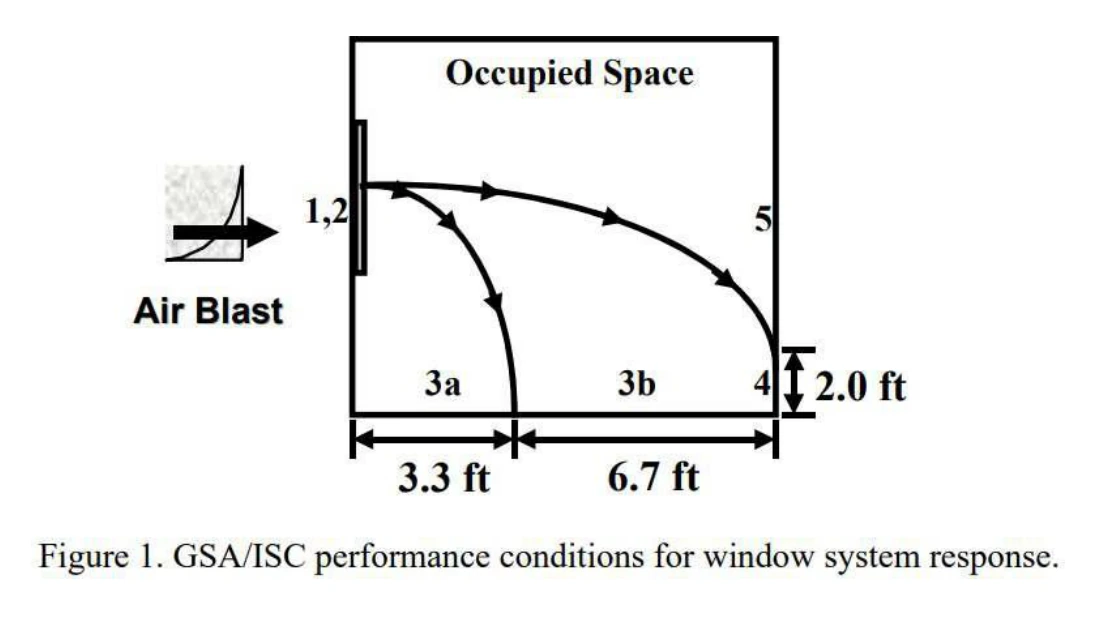
IWFA PDF page 28: fragment travel into occupied space drives the hazard assessment.
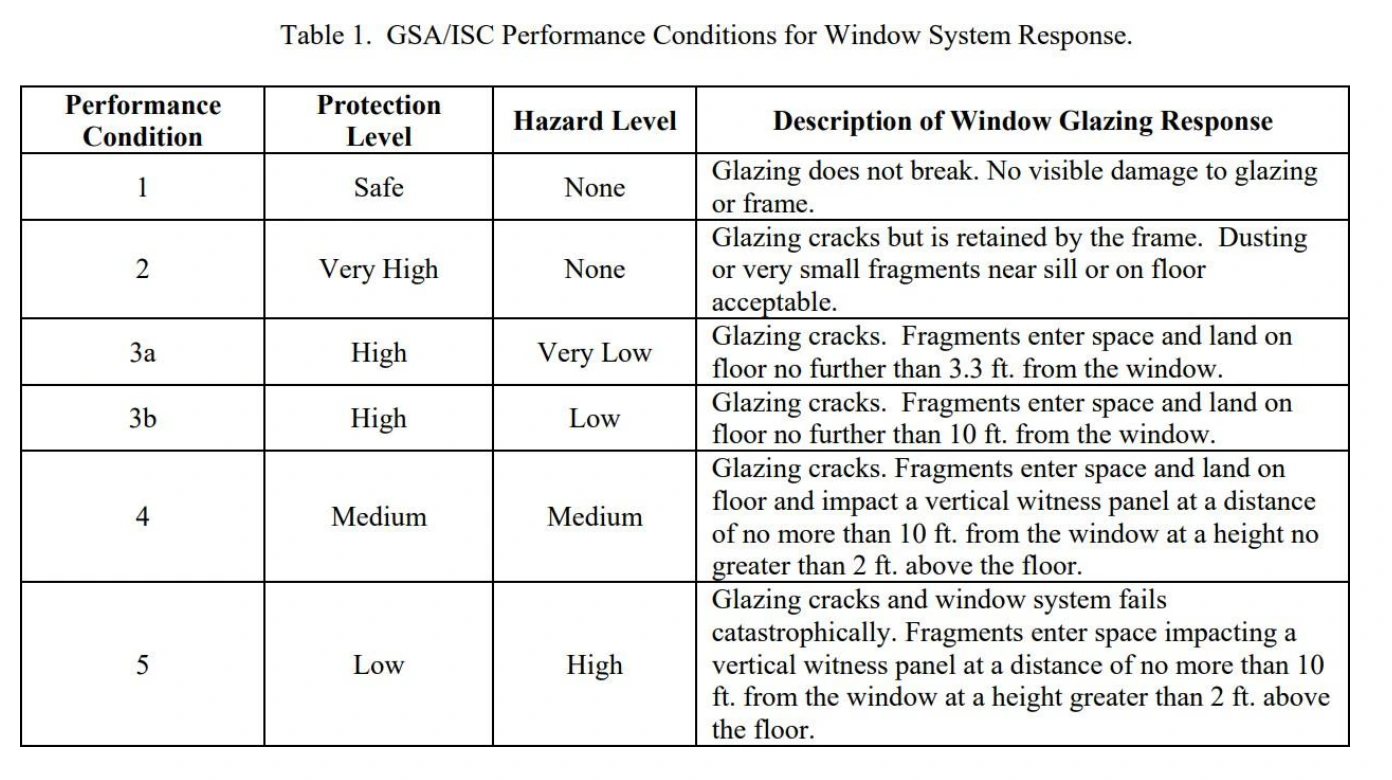
IWFA PDF page 28: the source table for Conditions 1 through 5; check the edition used in a project report.
- Condition 1: no visible glazing or frame damage in the table’s criterion.
- Condition 2: cracked glass stays in the opening; minor dust or fragments may be near the sill or floor.
- Condition 3a: fragments land no more than 3.3 feet (about 1 metre) from the window.
- Condition 3b: fragments land no more than 10 feet (about 3 metres) from the window.
- Condition 4: fragments strike the witness panel within 10 feet and no more than 2 feet (about 0.61 metres) above the floor.
- Condition 5: severe window damage and witness-panel strikes above 2 feet at the stated distance (IWFA PDF p. 28).
The manual describes properly framed laminated or polycarbonate assemblies and anchored safety film as possible ways of reducing fragment danger under tested loads. Even laminated glazing can leave an unsuitable frame. Cite the tested assembly, blast load and achieved condition together.
10 · FORCED ENTRYUL 972, EN 356 and the limits of active-shooter claims
A smash-and-grab attack depends on speed. Delaying a usable opening can buy response time, but it does not guarantee that determined attackers cannot enter. UL 972 uses repeated steel-ball impacts under specified conditions. The manual notes that UL requires the frame as part of a passing system report rather than issuing one for glass and film alone. EN 356 P1A/P2A uses a heavier ball dropped in a set pattern at defined heights. The achieved level applies to the tested glazing construction (IWFA pp. 28-29).
For an active-shooter scenario, IWFA states that safety film on existing glazing is not bullet-resistant or bulletproof. A particular system test may measure how long entry is delayed, but its weapon, ammunition, distance, glass and anchoring must be disclosed. Entry-delay evidence cannot be turned into a bullet-stopping claim (IWFA p. 29).
Anti-graffiti film serves another purpose. It can act as a replaceable sacrificial layer against scratching or chemical marking. Surface protection is not evidence of forced-entry resistance.
UL 972: repeated impacts and penetration
For smash and grab, the manual describes film on the rear face of glass to simulate attack from outside. A five-pound steel ball is dropped from ten feet onto a 24 × 24-inch specimen, with five blows near its centre. The described criterion prevents ball penetration in at least nine of ten specimens for each test condition; the guide also describes temperature conditioning and a higher-energy 40-foot drop (IWFA PDF p. 29).
Sharp broken annealed glass can cut film during repeated blows. The guide cautions that UL does not issue a passing result for film and glass alone without a frame. Ask for the tested framed assembly and the actual result before using UL 972 in a sales claim (IWFA PDF pp. 29-30).
EN 356 P1A and P2A: different drop heights
The manual’s example uses a 4.11 kg steel ball and three 1,100 × 900 mm specimens. Each takes three drops in a triangular pattern, nine in total, without penetration. P1A uses a 1,500 mm drop; P2A uses 3,000 mm. These are the two example classes discussed in the guide, not a summary of all EN 356 classes (IWFA PDF p. 30). Attack method, desired delay, glass thickness and frame determine whether a result applies to another opening.
For active-shooter discussions, an entry-delay test must disclose firearm, ammunition, distance, glazing and attachment. Delay is not bullet resistance. Anti-graffiti film is another category: a replaceable sacrificial surface against scratches or chemical marking, sometimes specified for exterior exposure. It does not itself prove intrusion resistance (IWFA PDF p. 30).
11 · EDGE RETENTIONDaylight, edge-to-edge and anchored film installation
Once film holds broken pieces together, another question follows: will that sheet stay in the opening? The edge detail and its connection to the frame often decide the answer.
In a daylight installation, film covers the visible glass and stops a short distance before the frame. This common method can retain fragments in some human-impact and rapid-break-in scenarios. With shattered tempered glass or a larger load, however, the filmed sheet may leave the opening.
Edge-to-edge application covers the pane to its edges, commonly before glazing. An anchored assembly ties film to the frame through a mechanical fitting or a structural-silicone wet glaze. The manual gives a minimum 3/16-inch overlap onto film/glass and frame for the wet-glaze example, but the specification must follow the design and test report for the chosen system (IWFA pp. 29-31).
Anchoring can substantially improve retention under some tested loads. It needs more design and installation work, and it does not by itself certify storm, blast or intrusion performance.
Daylight and edge-to-edge are different installations
Daylight installation is common on existing windows. The guide describes some retention of annealed-glass fragments under human impact, small debris or limited blast in tested circumstances. Tempered glass may leave as an entire filmed sheet after it granulates if nothing restrains the edge. Edge-to-edge applies film to the whole pane before glazing it into the frame; cutting retrofit film close to an existing frame is not necessarily the same construction (IWFA PDF p. 31).
Mechanical and wet-glazed anchoring
One mechanical method overlaps film onto a frame and holds it with a batten, possibly at the top, two opposite sides or all four sides. Another starts with daylight film and uses a flexible, adhesive-backed hinge-like strip between film and frame. A wet-glazed method replaces part of the existing seal with a designed structural sealant overlapping film/glass and frame. The manual gives 3/16 inch as an example minimum overlap, not a universal instruction to use any silicone (IWFA PDF pp. 31-32).
Specify the sealant, substrate preparation, overlap, cure and attachment sides from the engineered system and its test report. Anchoring changes cost and appearance as well as retention; an earthquake or blast claim needs a report with the same anchoring geometry as the proposed pane.
The following MAXXMA channel video illustrates architectural and safety-film applications. It is context for the installation conversation, not a test report or evidence of a standards pass.
How to check a safety claim against its actual test report
When you read “tested to a standard,” ask one more question: was it tested with the glass, frame and installation planned for this opening? The details matter more than a large standard logo on a brochure.
IWFA’s advertising guidance calls for recognised, repeatable methods applied to the product actually sold. Where a standard has a pass criterion, the tested assembly must pass it. Where it has several classes, the claim must identify the class achieved rather than the class attempted. Reports should disclose glass type and thickness, specimen size, film, frame, attachment, units and test conditions. A comparative claim needs comparable filmed and unfilmed tests (IWFA pp. 11-12, 33-34).
The practical question is: Was the tested assembly the one proposed for this opening? Changing a thick pane to thin glass, anchoring to daylight fitting, or a new frame to an old one can invalidate an inference. Terms such as “bullet proof”, “hurricane proof” and “burglar proof” should not replace a matching system report and a clearly bounded result.
Six checks before repeating a safety claim
- Identify the tested glass: type, thickness and, for system tests, specimen and frame details.
- Use the report’s units and method: do not mix peel force, tensile strength and impact energy.
- Test the product offered for sale: raw PET or a different film is not the installed product.
- Name the class achieved: an attempted but failed class is not a pass.
- Support comparisons on both sides: comparable filmed and unfilmed specimens and accessible reports.
- Use recognised, repeatable methods for life-safety claims: a demonstration video is not an event-specific test (IWFA PDF pp. 12-13, 34).
The guide cautions against using unusually thick or uncommon glass to imply a result for ordinary existing windows. Ask where the report’s scope ends before approving copy.
13 · STANDARDS AND PLACEInternational test standards do not approve a building in Thailand
The guide describes agencies including GSA, the US Departments of Defense, State and Homeland Security, and FEMA in their respective procurement, security and disaster roles. Mentioning an agency in a manual does not mean that every agency endorses a film product (IWFA pp. 31-32).
ANSI, ASTM, UL, EN and ISO methods give designers a shared language for testing. Actual building requirements depend on jurisdiction, building use, opening location and the current edition of each standard. For life-safety work, the responsible designer and local authority must check the current rules.
GSA’s civilian facilities, the Department of Defense’s protective needs, the Department of State’s overseas facilities, DHS’s security remit and FEMA’s disaster work provide different US contexts. None of their names in this guide is an endorsement of a MAXXMA product. Appendix A lists material-property reporting methods; the US building risk categories at the back of the manual are examples, not Thai approval criteria (IWFA PDF pp. 32-35).
Our reading for Thailand: Florida hurricane tests and US government blast ratings take up substantial space in the manual. Thai official sources cited here instead draw attention to local gusts and the 2025 earthquake. The difference is in the hazard being assessed and the authority that approves a project, not a ranking of standards. Before applying an international result in Thailand, check the Department of Public Works and Town & Country Planning’s law and standards search and the rules for the building in question.
14 · DECISION CHECKLISTSix questions to answer before specifying safety film
Take these six questions into a supplier conversation before asking for a thickness. They help reveal whether the report describes your opening or simply the film material.
- Which event is the project trying to mitigate: human impact, storm debris, intrusion, blast or another hazard?
- What are the existing pane type, thickness, dimensions, frame, seal and frame-to-building connections?
- Is there a test report for a matching glazing assembly, rather than film alone or a demonstration video?
- What level did the assembly actually achieve, under which standard edition, units and adhesive cure conditions?
- If solar-control layers are included, has film-to-glass thermal compatibility been checked?
- Has a qualified safety and building professional reviewed the design and local requirements?
Match each hazard to the evidence requested
- Human impact at a door or low partition: ANSI Z97.1 or CPSC 16 CFR 1201 report, achieved class/category, glass and edge details.
- Windborne debris: ASTM E1886 with the applicable E1996 level or current local method, including cyclic pressure and the full framed specimen.
- Seismic fallout: racking report with SDL, UDL or measured fallout, pane size and anchored edges.
- Blast fragments: load, pressure/impulse, achieved hazard condition and assembly details under F1642/F2912, GSA TS01 or the applicable ISO method.
- Smash and grab: UL 972 or EN 356 class for the tested assembly, including tool or ball, weight, repetitions and pane size.
- Surface scratching: anti-graffiti film replacement and weathering information where installed outside (IWFA PDF pp. 13-32).
Before accepting a specification, compare the report with the project’s glass thickness, film face, pane dimensions, frame, seals, installation and cure. Record any mismatch for the responsible professional to assess.
For many Thai homes and shops, a useful survey starts with doors and panes people pass close to, then exposed windows and potential windborne debris. Where shaking is a concern, check whether broken glazing would remain in its frame. Assess blast or forced-entry needs against a site-specific threat. This is our suggested way to organise a survey from the manual and the Thai sources above, not a universal building requirement.
To assess solar performance alongside safety, read our architectural RAT, SHGC and TSER guide. To begin a glazing assessment, contact MAXXMA with the glass details and the hazard you need to address.
15 · QUESTIONSFrequently asked questions about safety and security film
Pick the question closest to your window and open one answer at a time.
Does safety film stop glass from breaking?
No. Glass can still break. Film may hold fragments together under tested conditions, but the filmed sheet can leave its frame if the load or edge retention exceeds its capacity. Ask for a result from the matching assembly.
Is thicker film always safer?
Thickness describes one material property, not every outcome. Glass, adhesive, frame, attachment and the level achieved in an event-specific test determine what the evidence supports.
Does an ANSI Z97.1 pass prove storm resistance?
No. ANSI Z97.1 assesses human impact. Storm testing combines specified debris impact and repeated wind pressure on a framed assembly. A pass in one method does not replace the other.
Where should a Thai home or shop begin its survey?
Start with doors and glazing near people, then review exposed panes and nearby objects that could become windborne debris. Record the glass type, frame and seal condition before choosing a film. This is a survey priority, not a certificate that other panes are safe.
What should be checked after an earthquake?
Have the responsible team inspect cracks, frame movement, loose fittings, seals and anchors. Damage needs professional assessment before the opening is used again. Film that still looks attached does not establish that the glazing or structure is sound.
Is safety film bulletproof or blastproof?
Do not make that general claim for film fitted to existing glass. It does not turn a pane into bullet-resistant glazing. Blast-fragment mitigation needs a stated load and achieved hazard level for the matching glass-and-frame assembly.
Should the film stop at the edge or attach to the frame?
Choose from the hazard and the desired result after breakage. Anchoring can improve retention in a tested system, but pane size, frame, installation and report must match the real opening.
References and limits of this guide
- International Window Film Association. Safety & Security Education Guide (2023). Primary source for the Thai article on which this English adaptation is based. Its cover and the figures cropped from PDF pages 8, 9, 10, 11, 15 and 28 appear here with attribution. This is not an official IWFA translation.
- References to ANSI Z97.1, CPSC 16 CFR 1201, ASTM D882, D1044, D3330, E84, E1886, E1996, F1642 and F2912, as well as UL 972, EN 356, GSA TS01, ISO 16933 and ISO 16934, explain methods discussed in the IWFA manual. They do not claim that a MAXXMA product has passed them.
- Standards and building rules can change after 2023. Use the current official standards and applicable law when designing or approving a project.
- Thai Meteorological Department, agricultural forecast for 29 April to 5 May 2026. Evidence of summer thunderstorms and gusts in Thailand, not a design wind load for a specific building.
- Thai Meteorological Department, Myanmar earthquake record, 28 March 2025. Event and felt-shaking reports, not a survey of glazing damage.
- Department of Public Works and Town & Country Planning, law and standards search. Starting point for checking applicable Thai requirements.
Ready to protect your home or vehicle?
Consult with MAXXMA experts to select the perfect film for your needs, or find an authorized dealer near you.